Deprecated: Creation of dynamic property ET_Builder_Module_Comments::$et_pb_unique_comments_module_class is deprecated in /home1/agileau1/public_html/wp-content/themes/Divi/includes/builder/class-et-builder-element.php on line 1425
Agile around the world – a chat with Cristina Welle
Originally from Germany, Cristina Welle built her career predominantly in Europe. However, after a brief stay in Australia, she fell in love with the country – and now, we’re lucky to have her here for good!

As a bit of background, you’ve been working across many industries and continents in recent years, have you noticed any patterns in what challenges different cultures are facing?
I would say that change and adopting a new way of working is difficult for everyone, regardless of culture or organisation. The most consistent question I’ve received in the many interviews I’ve had lately is how does one manage resistance to change, especially when it’s forced upon them?
I’ve learned that I can’t change a person directly, nor should I try. What I can influence is their environment, which creates the conditions for a shift in mindset to happen naturally. It always reminds me of this quote by A. Den Heijer: When a flower doesn’t bloom, you fix the environment in which it grows, not the flower.
Take, for instance, a leader who has been working a certain way for 20 years. Asking them to abandon their old processes is an enormous ask. It’s crucial to meet people where they are, genuinely understand their concerns, bring compassion, and guide them through change incrementally. Organisational transformation is a journey, not a quick fix.
Fear often plays a significant role in resistance to change—fear of failure, fear of letting go, and fear of the unknown. Before pushing for change, we need to acknowledge and understand these fears. The key to addressing them lies in practicing compassion and patience while adopting a strategic and holistic approach. By doing this, we create an environment where people feel supported and empowered to embrace new ways of working.This often requires significant mindset shifts at both leadership and team levels.
Another universal challenge is the pace of change. And this brings my thoughts to this formula from I. Newton: f = ma. Force equals mass times acceleration. When the mass we aim to move is big, we must apply more force. If we wish to change the direction of a large company or solve a meaningful problem, we need to apply a substantial force. This is often what we do. We implement repositioning or a major reorg. The challenge with applying big force to anything, however, is that it unsettles us. We fear it may cause more harm than good, undermining the circle of safety. But, there is another variable that we often ignore: the “a,” which represents acceleration. Who says changes have to be super quick or happen all at once?
Interestingly, I’ve also noticed that trust and psychological safety are foundational challenges across the board, regardless of culture. Building an environment where people feel safe to fail, share ideas, and offer honest feedback is often the first step in making agility successful.
Ultimately, while the manifestations of these challenges might differ based on cultural context, the need to align leadership, foster trust, and embrace change is a constant in every region.

There have been a lot of interesting conversations happening lately about the value of ‘Big A agile’, what does true agility mean to you?
As G. Booch wisely said: A fool with a tool is still a fool. We need to stop the bad big A agile!
All it’s about is fostering a mindset and culture that values adaptability, continuous learning and feedback, and delivering meaningful outcomes to user and market needs. True agility emphasises responsiveness over rigidity, collaboration over silos, and experimentation over perfection and all this by putting people first.
It’s about understanding the why—why we do what we do? It’s about being close to the people who use your product, truly understanding their needs and pain points, gathering feedback early, and iterating and adapting quickly based on their needs. Agility is not a standalone practice. It requires collaboration—whether with Business, Development, or Operations. To truly embody Agile, we need to take a holistic view of the organisation.
The way our organisation is structured around value—think here about value streams & team topologies—how our teams are aligned and how we communicate with each other, and the language we use, will directly affect the success of our efforts and the value we deliver. Agile has some inspirational ideas on how this can happen, but it requires a comprehensive, people-centered approach, leadership support and a mindset shift to truly take hold.
Before agility can work, we need to embrace a growth mindset to change, having the courage to step out of the comfort zone, encourage open communication, and create a safe space for people to express their ideas and concerns. Without that feeling of safety and trust, the process won’t work.

What would you say helps guide you when trying to help organisations do better work?
My greatest guides are compassion, patience, courage, treating people as human beings rather than human doings, sharing knowledge generously, and paying attention to what isn’t said. It’s important to stay open to everyone’s perspective—what might they see that I don’t see?
Meet the team where they are, with compassion and without judgment and understand the current state and the problem we need to solve. We all operate at different levels, have unique perspectives on things, and face different challenges.There is not about who is wrong and who is right—it’s about how we come together to do the right thing as a team. Teamwork makes the dream work!
Building trusted relationships and asking for help when needed is invaluable. Sharing knowledge and empowering others to take accountability for solving problems is equally important. But building trust and strong connections takes time and effort and being patient in a fast-paced environment can be challenging. It requires balance—staying calm and focused amid the urgency while still giving people and processes the time they need to unfold effectively.
And there’s another thing—it takes me back to the Agile Manifesto and makes me wonder, how can we bring both sides of it into harmony when solving problems or do better work? It’s not about choosing one side over the other; it’s about finding the balance.

Stay in the loop
To receive updates about AgileAus and be subscribed to the mailing list, send us an email with your first name, last name and email address to signup@agileaustralia.com.au.
In conversation with Elise Aplin
Most recently, Elise has been living the island life in Mauritius and will soon be returning home to Australia. We caught up with her to have a chat about what she’s been up to.
Can you tell us a bit about your background and professional journey thus far?
My background is specifically in health sciences, so I did some diagnostic science and then I wanted to move into bioinformatics. I decided to move into the technology space for a bit and then eventually thought I was going to end up back in science using my kind of tech knowledge for that. That never happened. I started working in technology consulting and I really, really liked it. Partly I liked the kind of hands on, let’s build, build something together and the creative side of it. And the other piece I liked was the collaboration side of things.
I’d always done a lot of sport growing up and it was always an individual sport and I’d find myself trying to create a team atmosphere around that. And so then when I had the opportunity to actually work in a way that was super collaborative, I was like -this is what I’ve been looking for. So I never made my way back to science and instead have kind of been in different spheres from consulting to working directly with startups. Now I’m freelancing, sort of just doing my own thing and yeah, kind of feel like I found the place for me.
What are your favourite things to do as part of your work now?
I like two really specific parts that are on the opposite ends of the spectrum. I love deep problem solving, whether it’s in the workplace or trying to solve a problem at home. In the technology landscape I am more on the product management side. I am not a hands-on software developer, but even in product management there’s a lot of problem solving that happens. How can we get eyeballs across what we’re building? What are the different pathways with say, not very much money? If you’re working for a startup where you can bring awareness to your product, what are the creative things we could do there? Sometimes it’s just as simple as, what is a creative way that we can communicate clearly that our product has a fee, but also not terrify people about that fee. So little things like that in the design of products I absolutely love.
The other piece I really like is helping people more effectively talk to each other in order to problem solve and collaborate. And I enjoy doing this beyond just the workplace. I encounter many times where people in the workplace, all people outside the workplace, are telling me about a situation that they’ve got. And my answer is always, well, just talk about it honestly. Like, don’t dance around that. That’s going to be uncomfortable to talk about, but it’s more uncomfortable right now.
I feel like I need to invite you to my Christmas dinner to help navigate all the spirited conversations! What are you most looking forward to in coming home from Mauritius?
One of the things about living in Mauritius is that there is a really small technology sector here. We’re trying to build a couple of communities. We started with Agile Mauritius. There’s a few conferences that take place here, but there isn’t the same ability to just easily reach out to somebody and say, hey, I’ve got this challenge. Can you talk through it with me? Or do you have ideas or resources that I could use?
So I’m looking forward to being back in Melbourne where I can just, you know, send somebody a quick message and say, hey, can we catch up for a coffee? I’ve got this gnarly problem that really needs another set of eyes on it.

You were in Mauritius when COVID hit, do you have any personal observations from your time there?
The interesting thing about Mauritius is that there isn’t a food delivery network here. Uber doesn’t exist in Mauritius, which means no Uber Eats and no big functional food delivery network. And this is relevant because in the first lockdown in Mauritius, we were stuck inside for, I think it was about 10 days, where you could not leave your house for any reason other than seeking medical support or if you were a frontline worker.
You couldn’t go to the grocery store, you couldn’t walk your dog, you were just inside. And this was a surprise decision. So people didn’t have enough food. So the government had to solve this problem of how do we get groceries to all of these people without, you know, having a Woolworths or a Coles.
What they ended up doing was looking at what companies did actually have logistics networks and it turns out to be things like big white goods providers similar to your Harvey Normans because they’re the sorts of companies that need to deliver because people can’t get a fridge home without a delivery service. So the first step in, how do we get food to people, was that the government partnered with companies that already had a logistics network and set up this food program where you could buy groceries online through these providers.
You couldn’t pick and choose what you wanted. So it wasn’t like, you know, I want one watermelon and five mangoes. It was, I want a food pack for two people. And they decided what a food pack for two people was. So you basically just said, this is the size of my household, please deliver me food. And it was really strange because you’re literally going on a white goods website to pick your food packs. But it worked.
The thing that I absolutely loved about this was it happened on a Friday and by Sunday people had piggybacked off this idea and you could buy beer packs. People just took pictures of like a huge stockpile of beer that they had and sent it out via WhatsApp and said you can buy a one person beer pack, a two person beer pack. So on Thursday, we had no food delivery network. Friday you could have food delivery for basic groceries. By Sunday you could have chocolate or beer delivery. It was amazing. It was literally watching innovation happen in real time.
And it was really cool to watch how simple it was to set up a business. You just needed a product, you needed a picture of that product and you needed a WhatsApp number. But they also didn’t yet have the permits allowing them to provide their service at that point, because the government hadn’t had the framework in place to allow the implementation of those ideas.
But when they saw how well people responded to this and the opportunity to make people’s lives easier in COVID, then the government retroactively was like, okay, we’ll give you permits that enable you to actually go out and be on the streets to deliver this stuff. So I think, often when I see companies wanting to innovate, they’re always concerned about the existing kind of framework that they have to operate in, rather than taking that big step outside that framework and saying, okay, let’s see if there even is a market for this. And once they realize that, hey, people do want this, then we can make sure that we actually have everything in place to fulfill that. As you know, COVID was a horrible time. And I don’t want to diminish the experience that anybody had, but one of the things that I really enjoyed about it was that, you know, strange, chaotic situations forcing people to think differently about how to solve problems and even what problems to solve.
That’s so interesting – and quite Agile if you ask me! People have been saying Agile is dead. What are your thoughts on this, and how does Agile actually manifest in your life?
There’s probably parts of Agile that are dead and probably should be dead. Big, capital A, Agile. But in terms of living a life in a way where you want to continuously improve – you’re already there.
Because the ideas of starting small, stopping, reflecting, checking, course correcting and continuing and that sort of iterative process with feedback loops – that’s the only way to actually continuously improve.
You set yourself a goal, you do the smallest thing you can to work towards that goal, you check whether or not it’s working, make decisions and you go again, I’m really goal driven. My goals aren’t things like becoming a CEO. My goals are things like learning to speak a language, going on a really exciting, six month camping trip. But I’m still driven by them and they still require skills that I like to work towards constantly and I like to see progress towards those skills.
This conversation has been edited for clarity. All thanks go to Elise for sharing her stories!
Stay in the loop
To receive updates about AgileAus and be subscribed to the mailing list, send us an email with your first name, last name and email address to signup@agileaustralia.com.au.
Chatting strategy with Dave Snowden
Ahead of his visit to The Deep Dive this March, AgileTODAY caught up with Dave Snowden to discuss Cynefin, the state of contemporary strategy, trekking, and more.
Dave, we can’t wait to welcome you Down Under for The Deep Dive, where you and Simon Wardley will explore how organisations can anticipate and exploit uncertainty. This won’t be the first time you and Simon have worked together—in what ways do your approaches complement each other?
Well, we are both proud of being cynics and curmudgeons 🙂 Remember, it’s the cynics who care, it’s why they stand out.
Both Simon and I want to enable people to understand where they are and where they are going without the need for heavy consultancy and highly constrained methods. We both dislike the fad cycle which has dominated management for the last few decades.
In terms of approaches, Cynefin provides a sense-making framework to talk about the type of decisions you make. It provides a method to determine the context in which you would ‘map’, and then assists in deciding where you move on a map. In Cynefin, Apex Predator theory is the closest direct parallel to Wardley Maps. Also, our real-time engagement of cognitively diverse resources provides a new tool for mappers and a means of reducing risk. There are many more parallels between our approaches, and more we’re still exploring. The Deep Dive will be a part of this exploration.
Your Cynefin Framework has been applied within a wide range of contexts—assisting with U.S. counterterrorism efforts, helping combat HIV/AIDS in South Africa, and guiding contemporary organisational strategy. You developed Cynefin back in 1999 at IBM; where has it been applied that you’re most proud of?
It’s the breadth of use that I’m proud of and the way people have used it to make sense of their world just by reading the material. One of the strengths of Cynefin is that it wasn’t just a one-time creation. Instead, it’s been an evolution of theory with practice over the years. The latest version is the liminal version, which is probably near-final as it resolves the question of disorder and transition.
The other thing is that as you use Cynefin more, you find more depth. Right at the bottom, there are specific frameworks for each domain which also stand in their own right. You can use these frameworks to create a common language between strategy and operations. Cynefin is also used a lot in conflict resolution. When a situation is complex, the only test for an idea is coherence – not whether it is ‘right’ or ‘wrong’ – so Cynefin allows people to make progress without needless and dangerous homogenisation. There is no need to paste over differences if you understand that what is ‘right’ or ‘wrong’ will emerge in time, it is not pre-given.
With 2019 marking the ten years since the GFC, I’m curious as to how you think corporate governance and strategy has changed in its aftermath.
That is a massive question. Governance we thought had improved, but then we get events like Trump and an abandonment of the norm, so the question is open at the moment. One of the factors leading to the GFC was an unbuffered feedback loop in trading systems. Buffers were put in for that; but we didn’t learn the lesson for the wider internet. Social media is now a threat not an opportunity. It lacks any inhibition, so perversion arises fast. We didn’t learn the lessons there.
Overall, the real issue is the use of a means of exchange to govern value transactions—and the blockchain doesn’t change that. Until we understand constraints (as in Doughnut Economics) and gifting (which is not a reciprocal transaction), we will continue to have models based on perpetual growth. As these models are inauthentic to the nature of reality, there will be more destructive cycles (obvious order to chaos in complexity terms) and governance is only a bandaid.
How does Cynefin interact with Agile, and are there any conflicts between the approaches? How could an Agile organisation benefit from structuring itself around the Cynefin Framework?
Cynefin allows a multi-method approach to select between different methods and tools. Scrum is very effective in the liminal domain between complex and complicated in Cynefin. In pure complexity, however, we need pre-Scrum techniques (and we have developed several, including unarticulated need management, forced mutation and trios), as well as a post-Scrum use of waterfall, timeboxes etc. The massive bureaucracy of things like SAFe represents the antithesis of Agile as it seeks Borg-like homogenisation. Cynefin is a light structure that allows you to determine when and where you use different methods and acquire new ones. SAFe is like a throwback to the ERP systems of a decade or so ago, which now provide issues with rapid updating to accommodate new circumstances. It’s an old model for a new age…
We are now starting to talk about moving from ‘being Agile’ to ‘gaining Agility’. Cynefin is important here, as it can link the various functions of an organisation in a non-linear way.
In your writings, you’ve emphasised the need to avoid homogeneity of thought when creating strategy. I agree with you that the views of people with “access to the knowledge assets of the organisation” – like “sidelined middle managers, secretaries and administrators” – shouldn’t be overlooked. How can leaders include these voices in discussions surrounding strategy?
I mean a lot more than that, it’s not just involving different functions; we need wider cognitive and experiential diversity at all levels and near real-time decision support. It’s interesting to see attempts at consultation and mass involvement – such as participative budgeting – failing to realise that anything that explicit will be gamed.
We use mass real-time engagement at a level of abstraction to gain an understanding of what underlies surface responses (thinking slow not thinking fast) and also to find people who are thinking differently about new problems. We seek to find the 17% who have seen something other people ignore (see the quote below).
“24 radiologists were asked to perform a familiar lung nodule detection task.
A picture of a gorilla, 48 times larger than the average nodule, was inserted in the last case.
83% of radiologists did not see the gorilla.
Eye-tracking showed that the majority of those who missed the gorilla looked directly at it”
–Drew, Vo & Wolfe
Psychol Sci. Sep 2013; 24(9): 1848–1853
The key is to separate situation assessment from policy formation—engagement needs to start there before you move onto policy formation. Ideation then needs to take place at a specific level where the decision maker is able to actually make a difference, rather than making statements about what other people should or might do. All of this is part of a broader complexity-based approach to strategy which handles the parts that more traditional techniques miss. One of the reasons organisations fail is that they get pattern entrained by past success so they don’t see emergent possibilities that break the mould.
You’ve also previously written about the need for leaders to “build personal integrity and trust with employees. Just as organisations are currently grappling with great uncertainty and rapid change, so are the individuals within them—with digital transformations calling job security into question. How can leaders practice integrity and build trust in this climate, particularly when their own organisational strategy may be causing unease among employees?
It’s all down to what you do, not what you say. Everyone is also forgetting that a lot of the jobs being hit by digitisation were an essential part of the apprentice models of learning that created current executives. Companies need to identify where human agency is needed and create systems with high levels of redundancy and longevity of employment to manage this—meaning smaller numbers but with security. Treating people as disposable assets means that, at best, they rent their knowledge to you rather than fully committing. Networks, or rather nodal networks, are also part of future organisational forms and few people are really thinking about that.
Finally, we’ve heard you’re a trekking fan—are there any trails in Australia you’re particularly keen to check out?
The whole of Tasmania—I am moving on from The Deep Dive to spend my 65th birthday there. In Sydney, I like the walk from Otford up to the ferry at Bundeena, although the new safety rails at the Wedding Cake rock are a disgrace and should be taken down. I’ve done various walks in the Blue Mountains and I’m thinking of some longer walks there. But (sorry about that) there is better walking over the Tasman!
Before Dave heads off to trek in Tassie, be sure to come along and join him at The Deep Dive; held 26-27 March at The Prince Hotel, St Kilda. More info here: http://thedeepdive.com.au/
Stay in the loop
To receive updates about AgileAus and be subscribed to the mailing list, send us an email with your first name, last name and email address to signup@agileaustralia.com.au.
#fragile: Feminist Revisionist Agile
In talks presented in Melbourne and Sydney this August, Portable COO Sarah Kaur presented a feminist revisionist interpretation of Agile. In Twitter discussion following the talks, the hashtag ‘#fragile’ (for ‘feminist revisionist Agile’) was swiftly adopted by attendees inspired by Kaur’s timely analysis. Here, we catch up with Kaur to learn why the future of Agile looks to be #fragile.
Kaur considers why the promise of Agile – a methodology the Harvard Business Review had hailed as “the competitive advantage for a digital age” – now appears to be breaking. “It’s not enough for us to say that Agile is ‘wrong,’” Kaur explains. “In order for Agile to be healthy in 10-20 years’ time, it must be worked on to ensure its great aspects remain.”
“If Agile is broken, let’s interrogate its structures,” continues Kaur. Using the lens of intersectional feminism, Kaur deconstructs the foundations of the Agile Manifesto. “Agile is influencing how the corporate world runs its projects. The time is now to unpack it and see how we can make it better!”
Why Feminism?
Intersectional feminism is built on the premise of interrogating established structures and unpicking their inherent assumptions —making it a useful tool to uncover why Agile isn’t working for everyone. This mode of analysis also accounts for the complex intersections that make up a contemporary workplace, where greater diversity exists in our staff, in our working hours and in the channels of communication available to us.
As Kaur points out, much has changed since the Agile Manifesto was written back in 2001. While those who wrote the Manifesto “would have had some differences – some were Scottish, some were American, some were Vietnam vets, some were aeronautical engineers – they were all pretty privileged, and kind of homogenic in comparison to today’s workforce.”
Portable’s all-women production team stands in stark contrast. Half the team is non-Caucasian, half are migrants to Australia. All are feminists. “The Agile Manifesto asks us to embrace that things change,” Kaur tells us. The Portable team believes feminism can effect this change, as “feminist thinkers have been remodelling the world around us… for a long, long time.”
Central to Kaur’s analysis is the unpacking of the binary oppositions contained within the Agile Manifesto 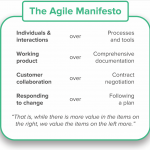 Kaur doesn’t demand that we totally discard the items on the left. Indeed, she accepts that ‘responding to change’ is a far better way of working than ‘following a plan’. Yet, informed by feminism’s call to question opinions purporting to be objective truths, Kaur examines the often-overlooked value of the items on the right.
Processes and Tools before Individuals and Interactions
Individuals and interactions are important but, Kaur notes, we need defined processes. “As the casualisation of the workplace increases, we rely more on a shared understanding of processes and tools to keep us aligned over remote and part-time work arrangements. How does your mum participate in a sprint when she’s working part-time?” Kaur asks. “It’s hard!”
As we’ve learned from cultural feminism, women are often responsible for maintaining social processes and tools; many of which are informal and, as such, are usually taken for granted. Women can be seen to act as a ‘gel’ or ‘social lubricant’, ensuring things like communication and relationship building run smoothly. This soft work is, in its own way, a process. “It’s always the little things,” Kaur explains, “comforting a colleague, remembering the birthdays, soothing an ego, showing a new employee the ropes. But these little things add up —and, for many women at work, they’re fed up.”
Kaur contends that tools and processes necessarily pave the way for interactions between individuals. Their role in the smooth functioning of a workplace can no longer be downplayed.
Comprehensive Documentation for Working Software
“Documentation is a form of democratising knowledge sharing,” says Kaur. “In tech especially, knowledge is power.”
The authors of the Agile Manifesto were pair programmers, meaning working code was easily comprehensible to them. But – fast forward to the present day – what happens when your developer goes on holiday? Work doesn’t stop. Your client asks you a question, and only your developer holds the answer. At the time the Manifesto was written, Kaur explains, “no one really had to understand these answers, bar those who were thinking the same. Why slow down and document stuff?”
As the above scenario illustrates, this rejection of comprehensive documentation doesn’t ‘work’ for everyone. It creates and maintains gaps in knowledge. It makes daily tasks needlessly complicated, particularly as the tech industry grows to encompass a broad spectrum of roles and skill levels. For Kaur, the question is raised: “who defines what ‘working’ means, and for whom does it ‘work’?”
Kaur argues that “knowledge shouldn’t be held in pockets of individuals’ heads.” Instead, we should document our processes in a shareable, easily comprehensible and teachable manner. Not only will this documentation simplify client communication; it could also serve as a valuable learning resource, allowing more people to access and contribute to these gated areas of discussion.
Contract Negotiation to pave the way for Customer Collaboration
“Contracts don’t work well with Agile,” Kaur tells us. Regardless of your work environment, there will always be someone (a client, a stakeholder, a third party provider, anyone!) who will require something.
Here, contract negotiation becomes critical. Kaur frames contract negotiation as an invaluable way to find out more about your partner: their expectations, their approaches and their non-negotiables. Trust is also built during the negotiation stage. “We’ve all heard that women are ‘good at compromising,’” Kaur laughs, referencing the “barbed compliment” that so many women receive. “Well, let’s turn this to our advantage!”
Kaur urges us to “reject the perception that women cannot negotiate.” Rather, she suggests that the negotiation process itself is flawed. Kaur draws on a Sheryl Sandberg quote: “People think that women don’t negotiate because they’re not good negotiators, but that’s not it. Women don’t negotiate because it doesn’t work as well for them.”
Kaur proposes that we make an effort to include women in contract negotiation from the outset, rather than merely having them step in when a ‘skilled compromiser’ is needed. Further, Kaur stresses the importance of women’s participation in the negotiation stage “so that we’re not bound to what someone else has decided are the rules.” If women are in the room when these negotiations take place, they can minimise harm and dismiss unreasonable conditions. Focusing solely on customer collaboration can exclude too many voices from the discussions that shape a project.
By framing negotiation as underserved by the Agile Manifesto – and as a forum that women can contribute to and reshape – Kaur blurs the binary between contract negotiation and customer collaboration. In Kaur’s words, we then have space to “make collaboration a deliverable with equal work from both parties.”
A #fragile Future
This isn’t about gender. For Kaur, #fragile is about challenging the cultural power structures that make Agile messy and difficult for everyone. Power structures and binaries are inevitable in all aspects of business; be it a client-agency binary or a founder-investor binary. So long as equal negotiation is prioritised, Kaur believes Agile can be a helpful future method of both dealing with and disrupting these power structures.
Kaur has noticed that too much emphasis can be placed on “doing Agile ‘right’. This shuts down discussion and stops people from wanting to give Agile a go.” Rather than treating Agile as a Bible, Kaur encourages us to adopt a mix of whatever Agile flavours meet our tastes and needs. In Kaur’s opinion, the only truly universal keys to making Agile work are trust and open communication.
Kaur leaves us with words from Agile Manifesto author Bob Martin: “Think of the Manifesto as a call to action in a point of time, and not a script of how to behave. It was a moment, not an era.” As this moment passes and we move to the next, the philosophy of Kaur and her team guides us in creating an inclusive, future-proof Agile.
https://hbr.org/sponsored/2016/04/agile-practice-the-competitive-advantage-for-a-digital-age
2“Uncle Bob Martin: The Agile Manifesto, 15 years later,” TechBeacon, 9 March 2016.
https://techbeacon.com/uncle-bob-martin-agile-manifesto-15-years-later
Stay in the loop
To receive updates about AgileAus and be subscribed to the mailing list, send us an email with your first name, last name and email address to signup@agileaustralia.com.au.