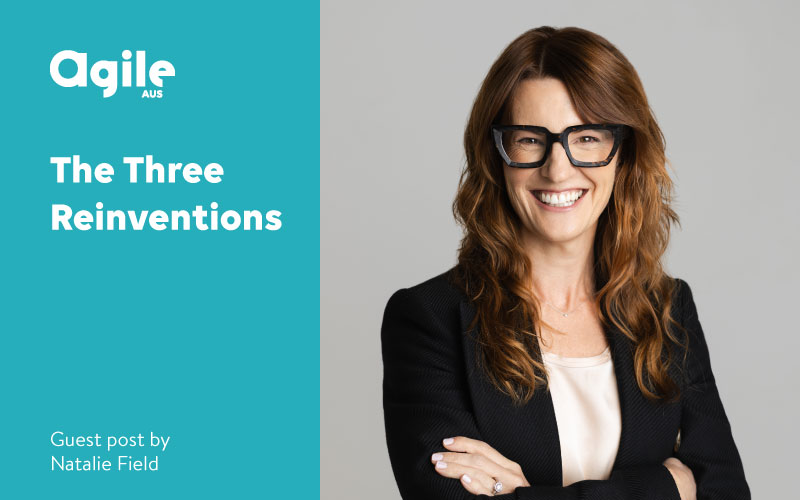
The Three Reinventions
What am I actually built on? AI is now forcing that question on every knowledge worker, every leader, every organisation. And my answer to it matters more than it has at any previous point in my career.
Reinvention one: by instinct
My first reinvention was not strategic. It was instinctive. I was drawn to roles where I had to build things, solve problems that crossed functional lines, and learn fast. That pattern put me in the deep end in a range of roles across multiple countries, spanning multiple industries. Each context looked different on the surface, but shared something underneath.
One of my leaders saw this before I did. Early in my career, James Kim told me something I did not fully understand at the time. He said he could put me in any role, in any company, in any industry, and I would figure it out. It took me years to understand, believe and feel what he saw.
What transferred across every context was not domain knowledge. It was the ability to walk into unfamiliar territory, read the system, build the relationships, and deliver. The thing that moved with me was not what I knew. It was how I learned.
Reinvention two: by design
My second reinvention started with a tool and became something more fundamental. When I completed CliftonStrengths for the first time, it gave me language for what had been driving my career all along. My top talents were not personality traits. They were the operating system I had been running without being able to name it.
That clarity changed how I made decisions. But the sharper shift came from a conversation over a cup of tea.
Andrew Walduck, a leader I turned to often for career perspective, said something that has stayed with me since. “Hope is not a strategy, Nat.” He was not being unkind. He was being precise. He told me I needed to stop waiting for the right opportunity to find me and start being clear about three things: what I had done, what I excelled at, and what I wanted to do next.
So I wrote it down. I created a document I called “Hope is Not a Strategy”: a clear articulation of my strengths, my purpose and my values. I revisit it every year to update what I have done and what I want to do. When I can say with clarity that my purpose is to create more than I consume, and that where I add most value is building high-performance teams that can create an ambitious vision AND execute, I stop applying for roles and start designing my contribution.
Reinvention stopped being something that happened to me. It became something I practised. What made the difference was this: reinvention without self-awareness is just movement. You accumulate experiences rather than compounding them. When reinvention is anchored in purpose and strengths, each move builds on the last. You unlock a different kind of energy: one that comes from progressing your purpose, not just your career.
Reinvention three: by necessity
I have spent twenty years leading digital transformation. I thought I understood what it meant to lead through technological change. AI has humbled that assumption.
The pace is not just faster. It is qualitatively different. The technology I am using today did not exist six months ago. The technology I will be using in six months probably does not exist yet. The old model was to build expertise, rise through the ranks, and protect your position. It no longer holds. What you know is worth less each cycle. How you learn and adapt is worth more. Your current position is not a place to protect. It is a platform to launch from.
The risk I am most alert to is what I think of as the empty loaf problem.
Imagine a village where a machine arrives that can bake perfect sourdough in seconds. The baker, delighted, stops feeding his starter. He stops kneading by hand. The apprentice never learns to feel when the dough is ready. The bread looks the same. But there is nothing inside. When the machine breaks, there is no craft to return to.
The same risk exists when leaders delegate their thinking to AI. The output looks coherent. The communication sounds polished. But the underlying craft quietly atrophies: the ability to ask the question nobody else thought to ask, to push past the first coherent answer to the truer one beneath it, to synthesise complexity, to make a judgment call under pressure, to see what the data cannot yet confirm. You produce the loaf without cultivating the starter.
This is not an argument against using AI. I use it extensively but deliberately. The argument is about what you choose to protect.
The thread
If I zoom out across all three reinventions, the pattern is this: through each reinvention, what I had to let go were the things tied to a specific context: roles, titles, domain knowledge. What I held onto were the things that are most distinctively mine: the ability to learn anything and draw energy from that process; to take something broad and ambiguous and break it into something that can actually be executed; to understand what people need, not just what they ask for; to build relationships where real trust and real results coexist; to hold both the vision and the execution without losing sight of either. These are not just capabilities. They are my strengths: the expression of how I am wired to think, to lead, and to learn.
AI can augment every one of those strengths. It cannot replace them.
The difference between reinvention that compounds and reinvention that drifts is whether you know what you are building on. Your purpose. Your strengths. The things that do not change even when everything around you does.
AI is going to force this question on every knowledge worker: what are you actually built on? If the answer is your title, your technical skill or your current role, you are standing on shifting ground. If the answer is deeper than that, you have something solid to build from.
I am building again. It is uncomfortable. Again. And I am more certain than ever that this is exactly where I am supposed to be.
What are you protecting in this reinvention, and what are you prepared to let go?
This blogpost was originally posted on Natalie’s LinkedIn in March 2026.

Stay in the loop
To receive updates about AgileAus and be subscribed to the mailing list, send us an email with your first name, last name and email address to signup@agileaustralia.com.au.